Long-Distance Caregiving: How to Track a Parent’s Medications Remotely
Your mother lives in a small town. You’re in Delhi. She calls you every Sunday. “Everything’s fine,” she says. “Don’t worry about me.” But you worry anyway.
Last month, your aunt mentioned your mother forgot her blood pressure medicine for a week. The week before that, she took yesterday’s diabetes pill again. You found out accidentally through a cousin’s WhatsApp message.
This is the reality of long-distance caregiving. You can’t be there. You can’t open her medicine cabinet and check. You can’t remind her at breakfast. You can’t see if she’s actually taking what she’s supposed to take.
The guilt is real. The helplessness is real. You’re supposed to be taking care of her. But you’re hundreds of kilometers away.
Most families just accept this situation. But you don’t have to. There are actual ways to keep track without hovering or invading her privacy.
Why Remote Medication Tracking Matters for Elderly Parents
When elderly people miss medications, things get worse. Maybe not immediately. But the damage adds up.
Missing medicines can make blood pressure, diabetes, or heart conditions harder to control. Over time, repeated missed doses may increase the risk of complications and urgent medical care.
Some research suggests digital health tools can help older adults manage medicines more consistently, especially when family members help set them up and stay involved. In a 2025 mixed-methods study of older adults in urban and semi-urban Aligarh, 42% reported improved medication adherence as a perceived benefit of using AI-enabled healthcare tools. Family support was associated with older adults’ experiences of using the tools. These findings come from one local sample and should not be treated as representative of every older adult in India.
The same study found that 52% of participants reported using at least one AI-enabled healthcare tool, including wearable monitors and teleconsultations. These tools are becoming more available, though access, connectivity, and comfort with technology still vary widely.
So the question isn’t whether you can track medications from far away. You can. The real question is how to do it in a way that actually works.
Practical Ways to Track a Parent’s Medications from Another City
Start With The Basics:
First, know exactly what she’s taking. Not “some pills for blood pressure.” Get the actual names. Dosages. What time. Morning or evening? With food or on an empty stomach?
Write it down. Keep it on your phone. Share it with other family members nearby.
Medication mistakes can happen when no one has a complete, up-to-date list of what the person is taking. Your mother may be taking medicines prescribed by different doctors. A neighbour may have recommended another product, and she may have been using an Ayurvedic medicine or supplement for years. Nobody may have the complete picture.
You need the complete picture.
Choose Your System:
You have options depending on your parent’s comfort level.
Simple SMS reminders: Your mother gets text messages at scheduled times. “Take your 8 AM BP medicine.” No app. No smartphone needed. Just texts. She doesn’t have to respond. She just gets reminded.
Smartphone app approach: If your mother has a smartphone (and nowadays many do), there are apps that send reminders and notify you when doses are taken. You can see from your phone whether she actually took the medicine or just got the reminder.
Smart pill dispenser: This is a machine that holds all her medicines. At the right time, it releases the scheduled dose and can reduce the chance of taking the wrong compartment or taking a dose twice. It still cannot guarantee that the medicine is swallowed. Depending on the device, it may also notify you when a dose is missed or left unconfirmed.
Combination approach: Most families actually use a mix. Basic reminders. Physical pillbox. Weekly check-in calls.
Overcoming Digital Literacy Barriers in Elderly Medication Management
Not every elderly parent is comfortable with technology. The same 2025 Aligarh study found that 49% of participants cited low digital literacy as a barrier to using AI-enabled healthcare tools. That’s nearly half. So if your mother is hesitant about apps, that’s normal. Not a character flaw. Just a real situation many families face.
The solution isn’t forcing her to use complicated technology. It’s finding what she can actually handle.
If she doesn’t know how to use a smartphone app, start with SMS. Just text messages. No app installation. No buttons to push. Just messages arriving saying “Take medicine now.”
Or use a physical pill organizer that you fill every week. Zero technology. Just a box with compartments. She takes whatever is in today’s compartment. Simple.
If she does use a smartphone, look for apps with large buttons. Simple interface. Not too many features. Just medication reminders and confirming doses. Nothing more.
Language matters too. Many elderly Indians are more comfortable reading Hindi or their regional language than English. Look for apps that support their language.
How to Set Up Remote Medication Tracking Without Making Your Parent Feel Watched
This is the delicate part. Your mother doesn’t want to feel like you’re spying on her. She wants independence.
Frame it correctly and it works. Frame it wrong and she’ll resist.
Don’t say: “I need to track you because you keep forgetting.”
Say: “This helps me worry less. I just want to make sure everything’s okay.”
Don’t say: “I’m setting up this app to watch what you’re doing.”
Say: “This is a tool to help you remember. And it lets me know if something goes wrong so I can help.”
Start simple. Don’t overwhelm her with complicated technology. Let her get used to one thing. Then add more if needed.
Research from the Aligarh study shows that when family members frame health technology as partnership rather than surveillance, elderly parents are more willing to use it. When adult children explain that the system helps them provide better care from far away, it makes sense. When it feels like monitoring or control, elderly parents resist.
Before sharing medication lists, prescriptions, or health readings with relatives, ask your parent what they are comfortable sharing and who should have access. Use caregiver permissions and privacy settings where available, protect the phone with a screen lock, and remove access when someone no longer needs it.
Step-by-Step Guide to Tracking Your Parent’s Medications Remotely
Step 1: Have The Conversation
Sit down (or call) your mother. Explain the situation clearly. “Mom, I’ve realized you’ve been forgetting medicines sometimes. It worries me. Let’s find a system that works for you.”
Make it about her wellbeing. Not about your worry. Not about proving she’s forgetful.
Step 2: List Everything
Every single medicine. Ask her to gather all bottles. Write down:
Name of medicine
Dosage (the number and unit)
How often (once daily, twice daily, etc.)
When (morning, evening, with meals, etc.)
What it’s for (optional but helpful)
Take photos of the bottles. Keep these photos. They’re useful.
Step 3: Choose The Right Tool
For basic phones: SMS reminders through services which offers free pill reminder functionality without requiring smartphone installation.
For smartphones: An app like MediWatcher that has a simple interface, shared caregiver access, and works offline. The app provides medication tracking for family members with features like missed-dose alerts and refill reminders.
For complex schedules: Consider a pill organizer box where you pre-fill her medicines weekly, organized by day and time.
Step 4: Set It Up Together
Don’t do this remotely if you can avoid it. Sit with her. Show her how it works. Let her try it a few times. Answer her questions.
Make sure she can confirm when she takes medicine. Or at least acknowledge the reminder.
Step 5: Test It
Before relying on it, test the system. Have her confirm a few doses while you check if you get notifications. Make sure alarms are loud enough. Make sure she actually hears them.
Fix any problems before making it official.
What Medication Tracking Apps Can and Cannot Do for Long-Distance Caregivers
Technology helps. But it’s not a complete solution.
Apps can remind her. But they can’t force her to take medicine. She still has to actually swallow the pill.
Trackers can tell you she got a reminder. But they can’t always tell if she actually took it (unless she confirms in the app).
So technology is a tool. It’s not a replacement for:
Regular phone calls to check in
Periodic visits if possible
Building trust that she’ll actually follow through
Having someone nearby who can also monitor
The best approach uses technology plus human support.
What to Do If Your Parent Misses a Dose
If your parent misses a dose, do not automatically double the next dose. What to do depends on the medicine, how late the dose is, and the person’s health condition. Check the medicine’s instructions or contact the prescribing doctor or pharmacist, especially for insulin, blood thinners, seizure medicines, heart medicines, or repeated missed doses. Note the missed dose in the tracking system and watch for a pattern.
How to Involve Local Family or Neighbors Safely
Even the best remote system works better with someone nearby. Share the medication list and reminder schedule with a trusted sibling, cousin, or neighbor who lives close by. Ask them to do a quick weekly check of the pillbox or simply confirm that the alarms are working. Keep the request light: “Just keep an eye once a week so I can stop worrying.” This creates a safety net without putting pressure on anyone.
MediWatcher: Free Pill Reminder and Medication Tracker for Long-Distance Families
MediWatcher is a free pill reminder and medication tracker built for Indian families managing care from a distance. You don’t pay anything for the core features most families need.
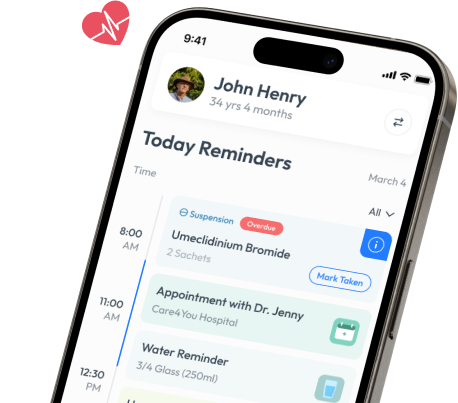
The app sends medication reminders at scheduled times. Your parent can confirm doses on their phone. You receive notifications when doses are taken or missed. Multiple family members can access the same parent’s medication data, so everyone stays informed without confusion.
It also lets you track vitals such as blood pressure and glucose levels, store prescriptions, and check for possible drug interactions. App-based interaction checks are a useful first alert, but they do not replace advice from a doctor or pharmacist, especially when multiple medicines or Ayurvedic products are involved.
The app works offline. Alarms ring even without an internet connection. When the connection returns, the data syncs so you can see updates on your phone.
Note: Digital tools support better tracking and reminders. They are not a substitute for medical advice. Always consult the parent’s doctor before changing any medicine, dose, or schedule.
Key Takeaways
In a 2025 Aligarh study, 42% of older adults reported improved medication adherence as a perceived benefit of using AI-enabled healthcare tools.
The same study found that 52% reported using at least one AI-enabled healthcare tool.
The study found that 49% cited low digital literacy as a barrier.
Because the study was conducted in urban and semi-urban Aligarh, its findings should not be treated as representative of every older adult in India.
Free options exist, including MediWatcher.
Frequently Asked Questions About Tracking Parent’s Medications from Afar
Q1: My parent refuses to use any app. What do I do?
Skip the app. Use the simplest option: SMS reminders or just regular phone calls at medication times. Or get a pill organizer and fill it yourself weekly when you visit. Low-tech solutions work fine. The goal is adherence, not using fancy technology. The Aligarh study found that family support was associated with older adults’ experiences of using digital health tools, but it did not prove that family support matters more than the specific tool.
Q2: What if my parent says they took medicine but I’m not sure they actually did?
If your parent agrees, they can video call during medication time. A simpler option may be a confirmation message or a photo of the pillbox after the dose. Keep it voluntary and supportive rather than making your parent feel watched.
Q3: How do I know if the app is actually working?
Test it first. Have your parent take a medicine while you watch. Check if you get notified. If yes, it’s working. If no, troubleshoot the app settings before relying on it fully. Make sure notifications are enabled on their phone.
Q4: Is MediWatcher really free?
Yes. MediWatcher is a completely free app with no hidden charges for basic features. Medication reminders, caregiver alerts, and vitals tracking are all free. No premium upgrades required for what most families need.
Q5: What if the doctor changes the prescription?
Update the list and the reminder schedule the same day. Take a fresh photo of the new bottles and share it with other family members.
Q6: How do I track medicine stock and refills from far away?
Note the quantity left when you set up the system. Most good apps (including MediWatcher) send refill reminders. You can also ask a local family member to check the bottles once a month.
Reference:
Rafi, S. Artificial intelligence and telemedicine in elderly healthcare: A mixed-methods study. BMC Geriatr 26, 71 (2026). https://doi.org/10.1186/s12877-025-06872-y
This information is for educational purposes only and does not replace professional medical advice, diagnosis, or treatment. Always consult a qualified healthcare professional regarding any medical concerns.
Track Your Health with MediWatcher
Set dosage reminders, monitor vitals, log symptoms, and keep your family informed.
Download Free AppIn This Article
Track Your Health with MediWatcher
Set dosage reminders, monitor vitals, log symptoms, and keep your family informed.
Download Free AppTake control of your health today with MediWatcher.
Download now and experience the ease of managing your health.


We use cookies to improve your experience
We use cookies to personalise content and ads, to provide social media features and to analyse our traffic. We also share information about your use of our site with our advertising and analytics tools.